Demo

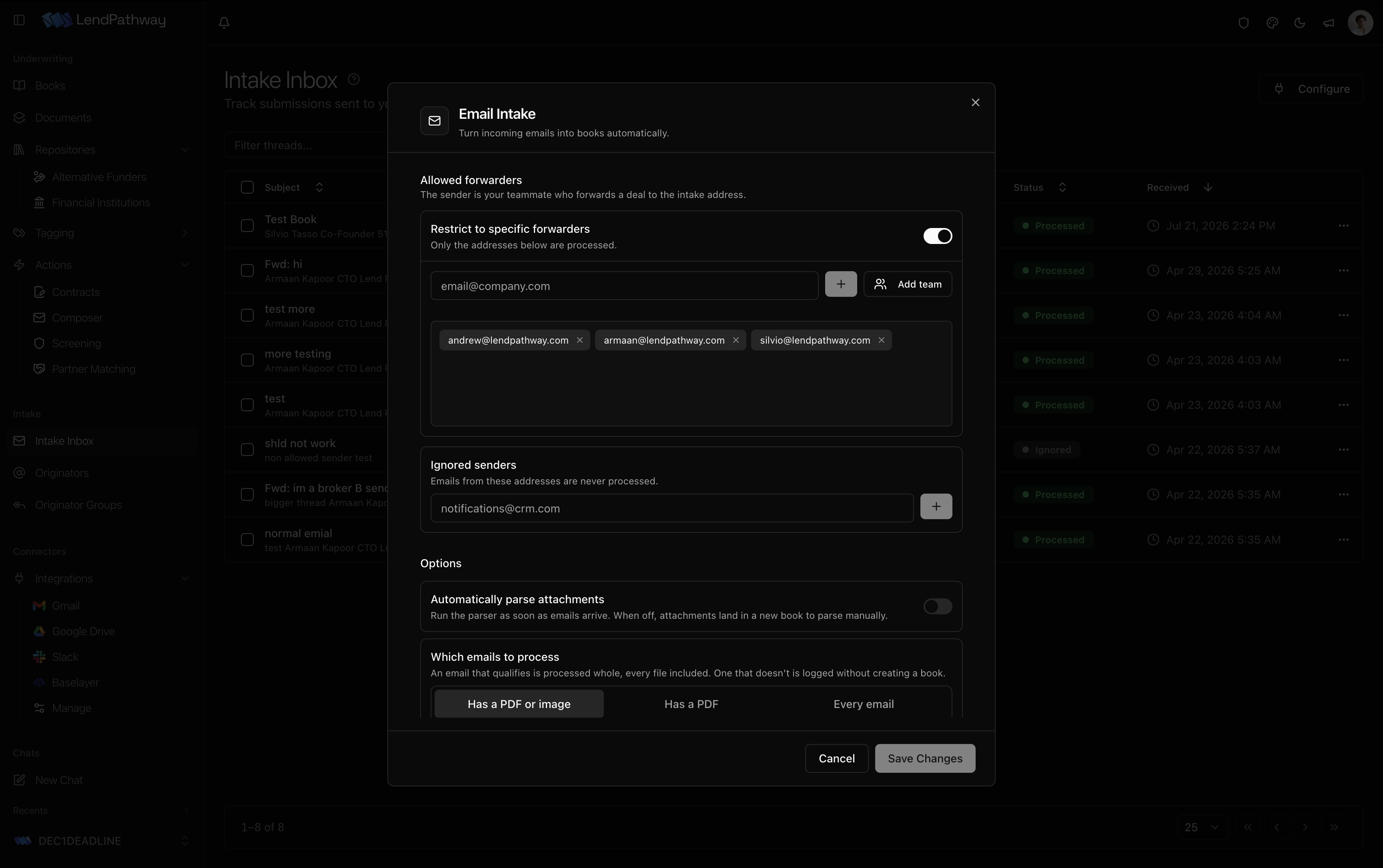
A modern underwriting studio.

Turn any financial document into underwriting signal.

Start free trial
Book a demo
TRY ME
Lexington CapitalCashableNewport Business CapitalBirkinQM AdvanceAventusLeoPreferred FundingKM Capital

The bank statement, decoded.

DateDescriptionAmountTag
Jan 15ACH Debit - Greenline Funding-$2,847.00MCA
Jan 15Returned Item Fee-$34.00NSF
Jan 16ACH Credit - BlueVine Advance+$15,000.00Factoring
Jan 17Zelle Transfer to Owner-$5,200.00Owner Draw
Jan 18Deposit - Stripe Transfer+$8,412.33Revenue
Jan 18ACH Debit - Kabbage Payment-$1,650.00Loan Payment

Line-item tagging.

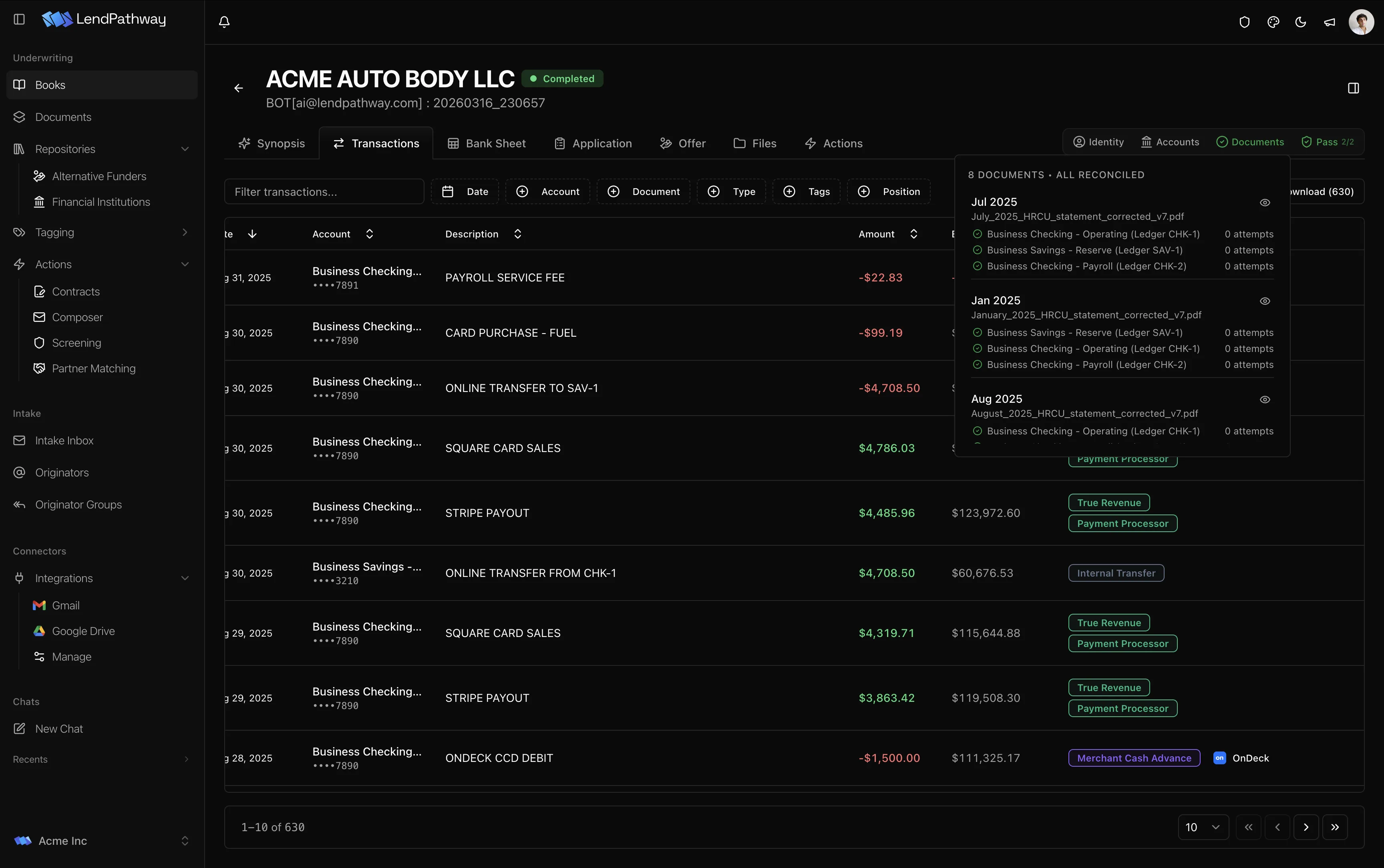
Every transaction tagged into a category. Debt positions, MCA stacking, risk indicators, and true revenue separated automatically.

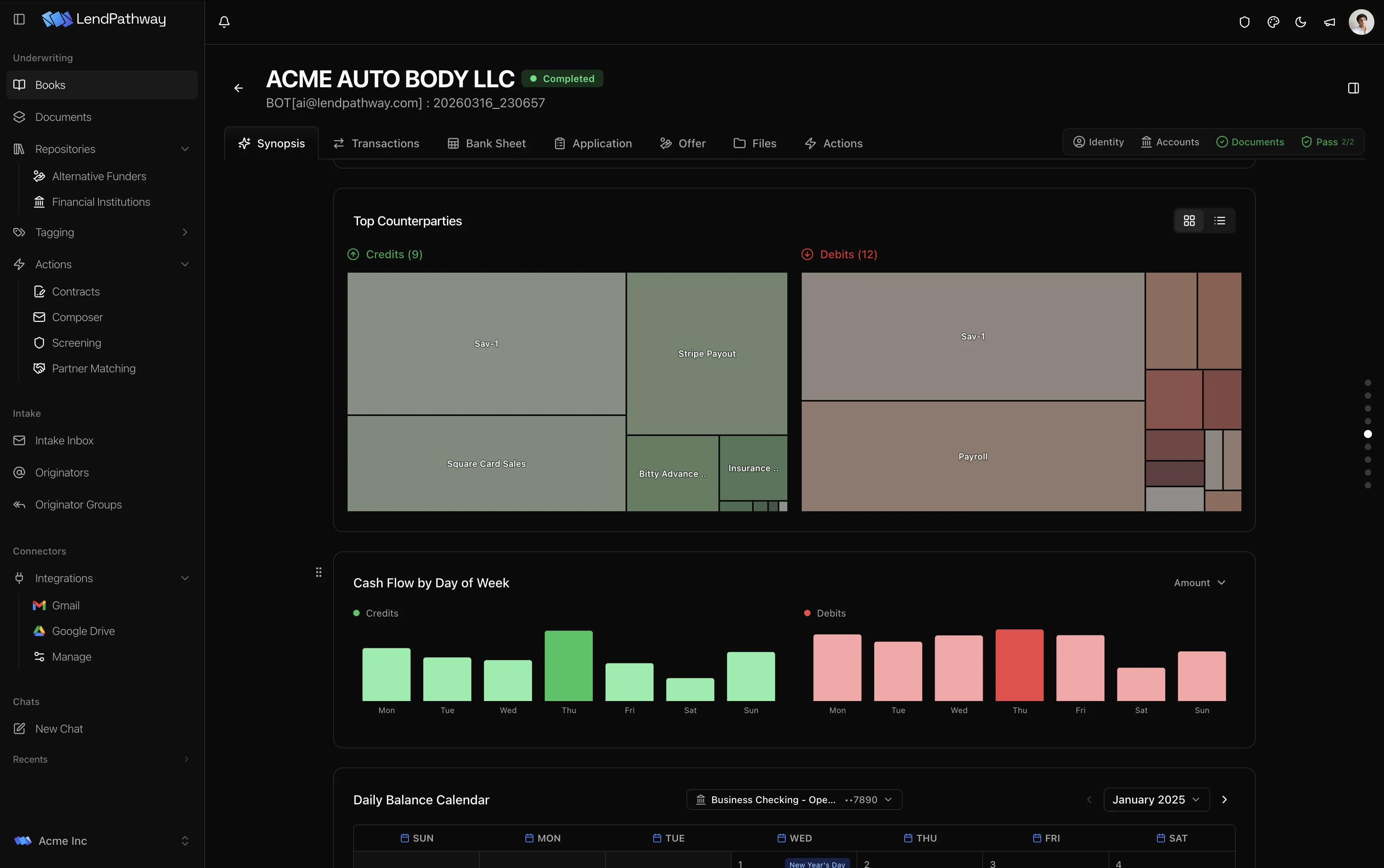
MCA positions and payment schedules. Loan disbursements and repayments. Invoice factoring. NSFs, negative days, and overdraft patterns. Internal transfers, owner draws, wire activity, Zelle and Venmo, journal entries, returned items. Debt activity separated from true revenue at the transaction level.

True Revenue

$281K

Daily Balance

+$24K

Debt Stack

$142K

Risk Signals
NSF Count7
Neg. Days12
MCA Count3
Debt Ratio0.42

Underwriting metrics.

Average daily balance, revenue trends, debt-to-revenue ratios, NSF frequency, negative day counts. Computed from the tagged data and ready to use.

Monthly and trailing revenue. Daily cash flow with inflow and outflow. Debt stack totals broken down by type. MCA position count and payment burden. All calculated automatically across every statement in the file.

Any bank format.

Chase, Wells Fargo, Canadian banks, regional credit unions, DecisionLogic exports. Vision-based extraction, not templates.

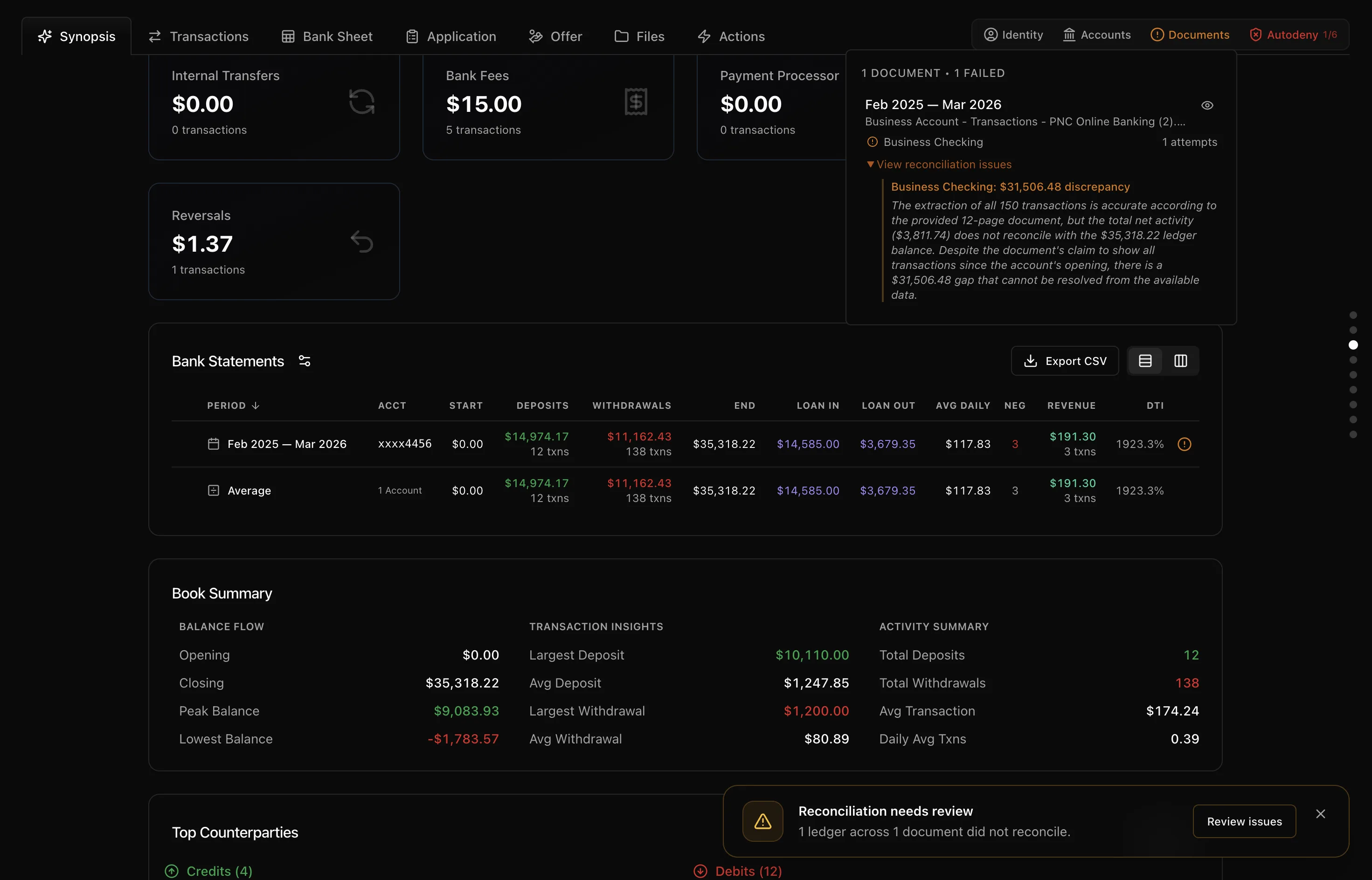
No format mapping or configuration per bank. Dates, descriptions, amounts, and running balances extracted per page. Reconciled against beginning balances, ending balances, and statement totals as an error-correction signal. Missing or duplicate transactions caught before they reach underwriting.

Credit reports, too.

Upload a personal or business credit report and get structured tradelines, scores, and risk signals back.

FICO 8 Score

742

Accounts

12

Inquiries

3

Utilization

52%

CreditorTypeBalanceLimitStatus
Chase SapphireRevolving$4,200$12,000Current
Amex Business GoldRevolving$18,750$25,000Current
US Bank Term LoanInstallment$42,300$50,000Current
Capital One SparkRevolving$9,100$10,00030 Late
Wells Fargo LOCRevolving$0$15,000Closed

Every tradeline, structured.

Each account classified by type and collateral. Balances, limits, status, and payment history come back as structured fields.

Revolving, installment, mortgage, and charge accounts. Collateral types like real estate, vehicle, and unsecured. Authorized users flagged separately from joint accounts. Self-reported accounts from SELF, Kikoff, Chime, and Experian Boost excluded from debt calculations automatically.

Tri-merge parsing.

Tri-merge reports, single-bureau pulls, MyScoreIQ exports. One file in, all three bureaus extracted in parallel with FICO 8 scores, inquiries, and tradelines.

Each bureau gets its own extraction call running in parallel. Subject identity (name, addresses, date of birth) is pulled in a separate pass so it stays clean. Works the same on single-bureau reports. Any format, any provider.

Subject

James R. Mitchell

DOB 04/1982

1247 Oak Valley Dr, Austin TX 78704Primary
892 Commerce St, Dallas TX 75201
Experian

742

Accounts14
Inquiries2
Equifax

738

Accounts12
Inquiries3
TransUnion

745

Accounts13
Inquiries2

Tax returns and K-1s.

Personal and business returns parsed into structured income, with K-1s matched to their parent entities.

Tax returns, parsed.

1040s, 1065s, 1120-S, Schedule C, and K-1s. Upload personal and business returns together and get structured income, depreciation, and ownership data back.

K-1s matched to their parent 1065 or 1120-S. Schedule E entities cross-referenced. Depreciation add-backs computed per form. Officer compensation, guaranteed payments, and ownership percentages pulled from every return. Multiple tax years grouped and compared automatically.

FormDescriptionYear
1040
Individual Return
AGI, W-2 Wages, Schedules
2023
1065
Partnership Return
Total Income, Ordinary Income, Depreciation
2023
1120-S
S-Corp Return
Total Income, Officer Comp, Depreciation
2023
K-1 (1065)
Partner's Share
Ordinary Income, Guaranteed Payments
2023
K-1 (1120-S)
Shareholder's Share
Ordinary Income, Ownership %
2023
Schedule C
Sole Proprietor
Gross Income, Depreciation, Net Profit
2023
Entity / FieldAmount
Ordinary Income
Mitchell Holdings LLC · 1065
$124,500
Guaranteed Payments
Mitchell Holdings LLC · K-1
$48,000
W-2 Wages
James R. Mitchell · 1040
$0
Depreciation Add-back
Mitchell Holdings LLC · 1065
+$18,200
Qualifying Income
Mitchell Holdings LLC · 1065
$190,700

Qualifying income.

Income from every form rolled up into a single qualifying number. Depreciation added back, K-1s matched to business returns, multi-year trends compared.

Follows Fannie Mae 1084 methodology. W-2 wages from the 1040, ordinary income and guaranteed payments from K-1s, depreciation add-backs from the business return. Schedule E entities cross-referenced to ensure nothing is double-counted. The final qualifying income number is computed per year with warnings for any missing or mismatched documents.

Supporting documents, covered.

The documents that round out an underwriting file. Same pipeline, same structured output.

ISO Applications

Business name, entity type, owner info, revenue, loan amount requested, use of funds.

AR Aging Reports

Customer receivables, aging buckets, days outstanding per row.

Customer0–3031–6061–90

Photo ID

Driver's license, passport, state ID. Front and back. Name, DOB, address, ID number.

Voided Checks

Account holder, bank name, routing and account numbers.

RTN
ACT

DecisionLogic

PDF exports parsed like raw bank statements. Same tagging, same output.

DescriptionAmtTag

Receipts

Vendor, amount, date, line items from purchase receipts.

See the whole picture.

Every document becomes a node in a structured graph. Explore how bank statements, credit reports, tax returns, and supporting docs connect into a single underwriting ontology.

Trusted across revenue-based financing.

From brokers to direct funders, the most efficient teams use Pathway daily.

Nicolette DiAntonio

Nicolette DiAntonio

Head of ISO Relations, Lexington Capital

The team over at Lexington loves LendPathway. It's significantly improved our productivity and makes reviewing bank statements incredibly easy. Clear, intuitive, efficient. We get our files out quickly with accurate information. They even personalized our view to display exactly what we need. Couldn't be happier with both the product and the support.

LendPathway takes a full year of statement data across multiple accounts and turns it into a clean underwriting breakdown in minutes. The position detection and payment cycle logic is the biggest time saver. We don't have to manually trace debits or rebuild our sheet anymore.

Ariel O'Neill
Ariel O'Neill
Head of Underwriting, Cashable Funding

LendPathway has materially improved the speed and accuracy of our bank statement analysis, making it an essential tool for our pricing team.

Noah Spellman
Noah Spellman
Business Development, Birkin Capital

Since integrating LendPathway, our underwriting has gone from a manual grind to practically on autopilot. The document parsing cleans up messy financial files and organizes everything into a streamlined, easy-to-read format. Fire-and-forget submission. It's honestly made my life so much easier.

Vlad Rusev
Vlad Rusev
Funding Specialist, Preferred Funding Group

Frequently asked questions.

Things you might be wondering.

Parsing
Bank statements, credit bureau reports, tri-merges, combined exports. The parser uses vision-based extraction instead of templates. It reads the information on the page and determines what to do with it based on what kind of document it is. New formats work immediately without any onboarding or configuration.
Bank statements, credit reports (single-bureau and tri-merge), tax returns (1040, 1065, 1120-S, Schedule C, Schedule E, K-1), loan applications, accounts receivable reports, DecisionLogic exports, photo IDs, and voided checks. You can upload month-to-date, year-to-date, and mixed business and personal accounts in the same PDF.
Every transaction gets extracted and every balance is reconciled against the source. Opening balance plus transactions has to equal closing balance. When something is ambiguous or low-confidence, it gets flagged for review instead of guessed at. Each parse job comes with verification scores so you can see exactly where the system is confident and where it wants a second look.
Most documents finish in under a minute. A full deal with 12 months of bank statements, a credit report, and tax returns typically completes in a few minutes. You can watch it process in real time or get notified when it finishes.
The parser handles it. If a single PDF contains statements from multiple bank accounts, or a mix of business and personal accounts, each one gets separated and processed independently. Same with combined files that include bank statements and tax forms together.
Underwriting
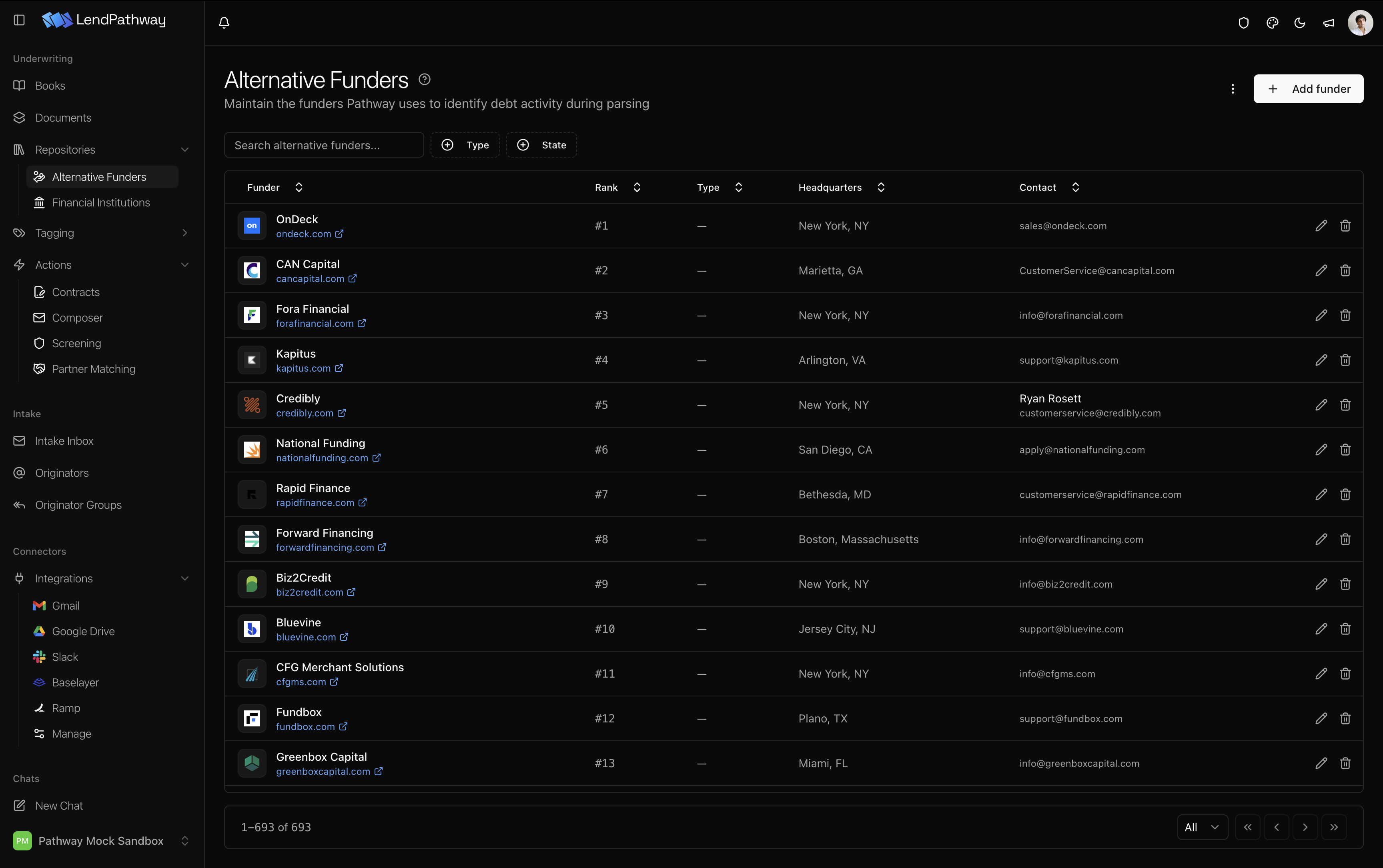
The system tags every transaction into 20+ categories including MCA payments, bank loans, factoring, NSFs, owner draws, payment processors, and internal transfers. It clusters counterparties across transactions, detects stacking positions with payment schedules, runs web research on business entities and principals, and checks for tampering indicators in PDF metadata and balance reconciliation.
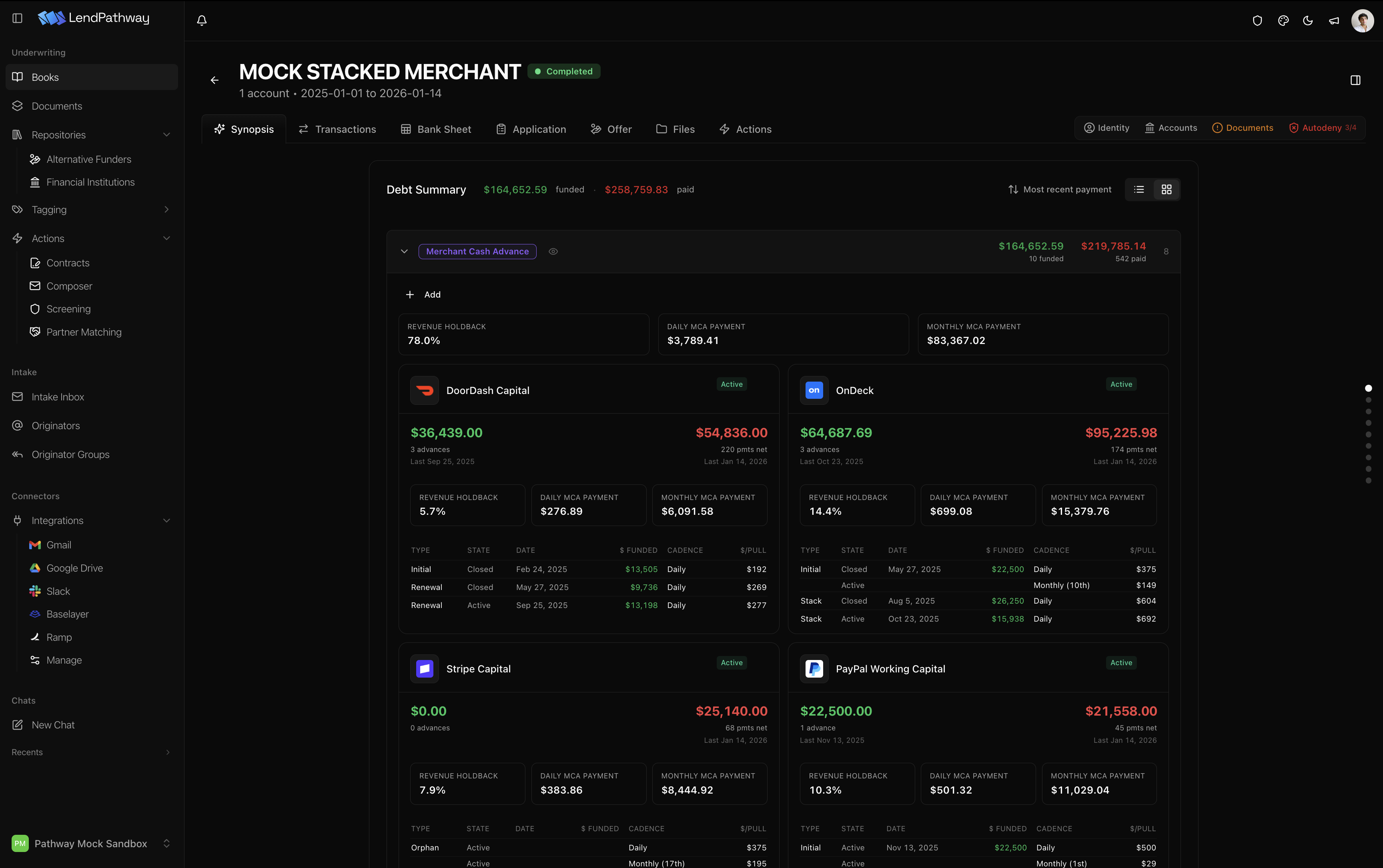
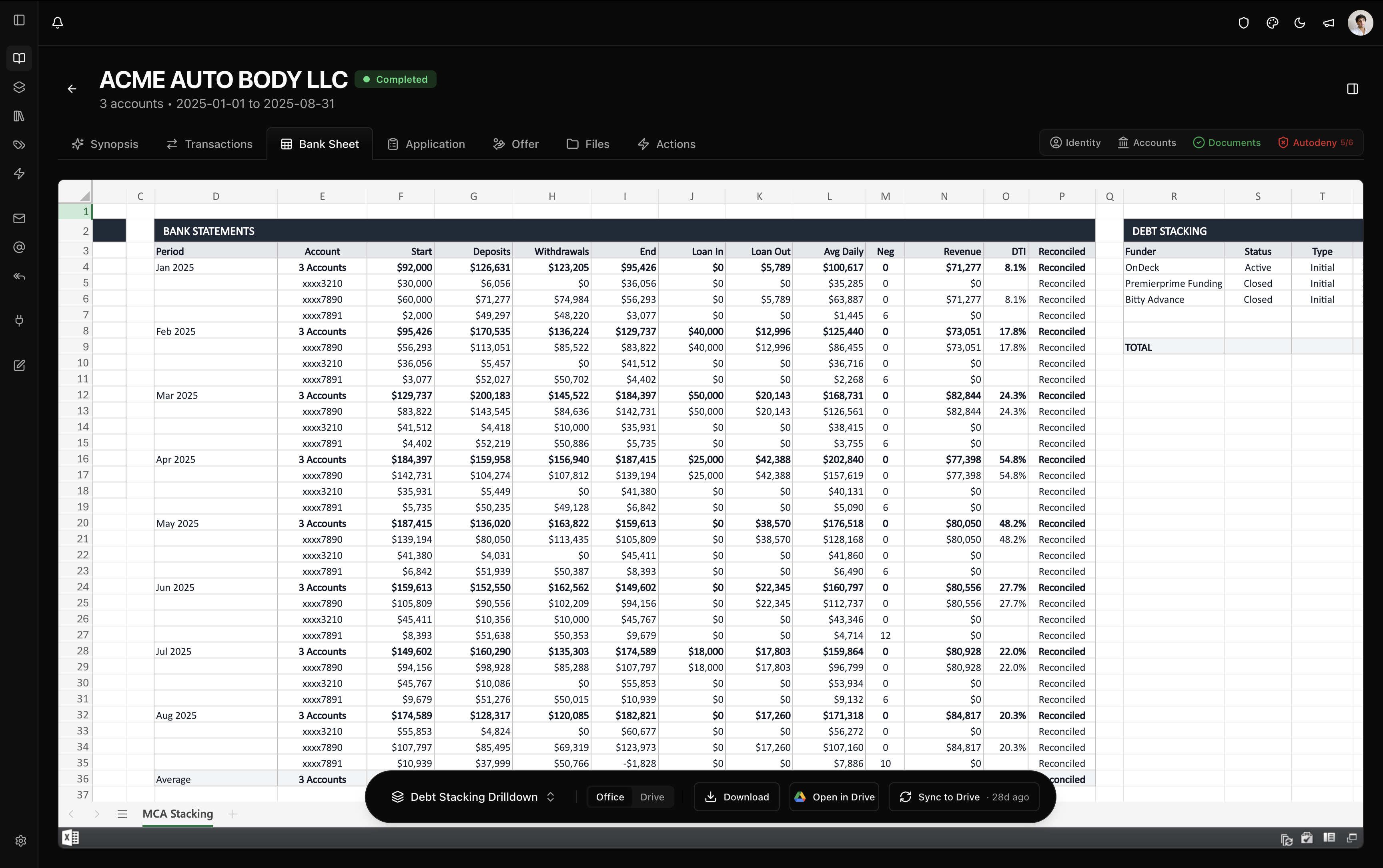
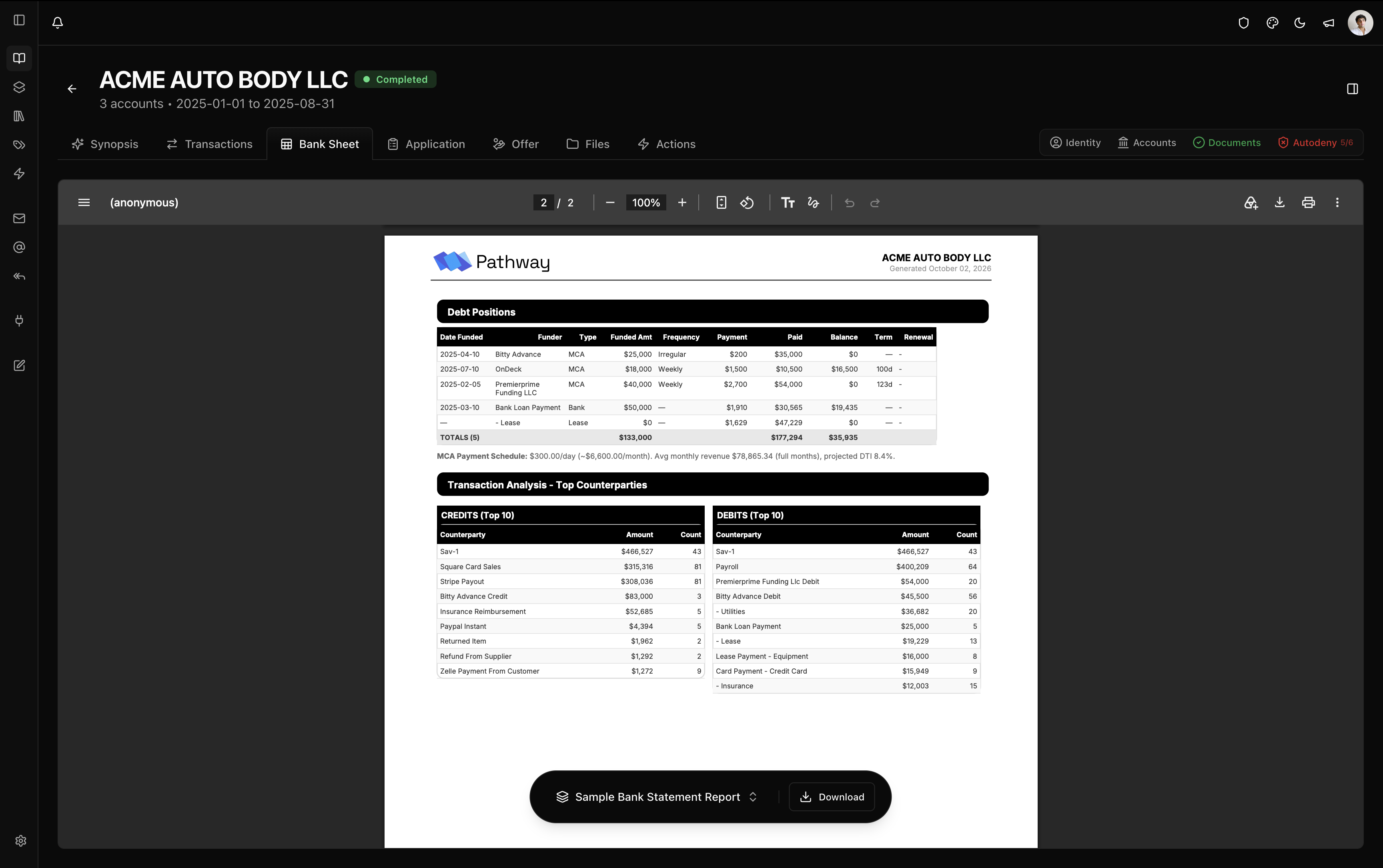
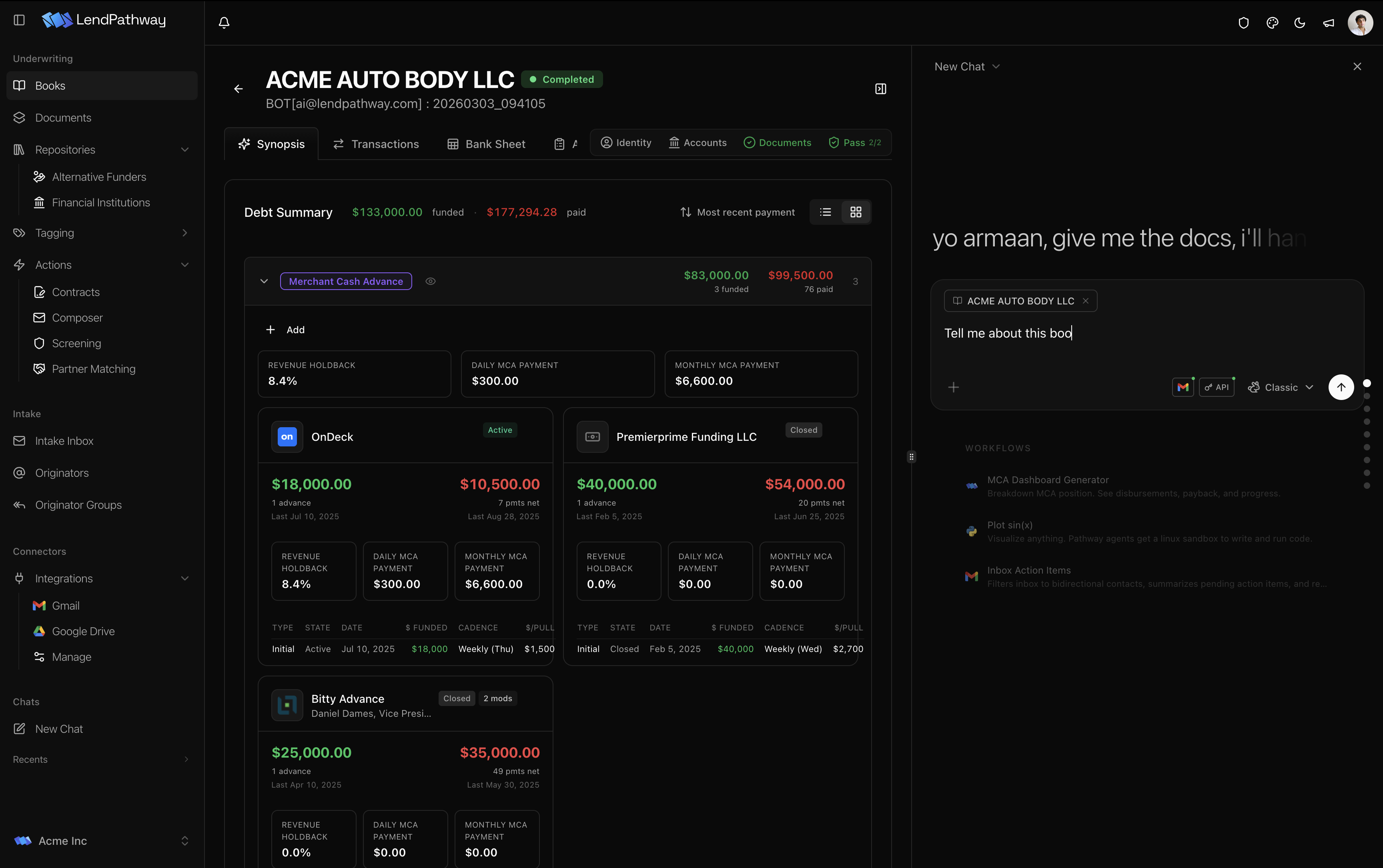
The parser identifies recurring debt payments and groups them by lender. For each position it shows the funded date, net amount, debit frequency, total paid, and whether the position is active or a renewal. This lets you see all overlapping obligations on a single business and calculate total recurring debt load.
The system checks PDF metadata for signs of editing, including multiple save markers, mismatched creation and modification dates, and suspicious producer tools. It also validates balance reconciliation across statement periods. Documents receive a risk score from 0 to 7, where higher scores indicate stronger evidence of intentional manipulation. Benign signals like scanned PDFs or mobile screenshots are accounted for and do not trigger false positives.
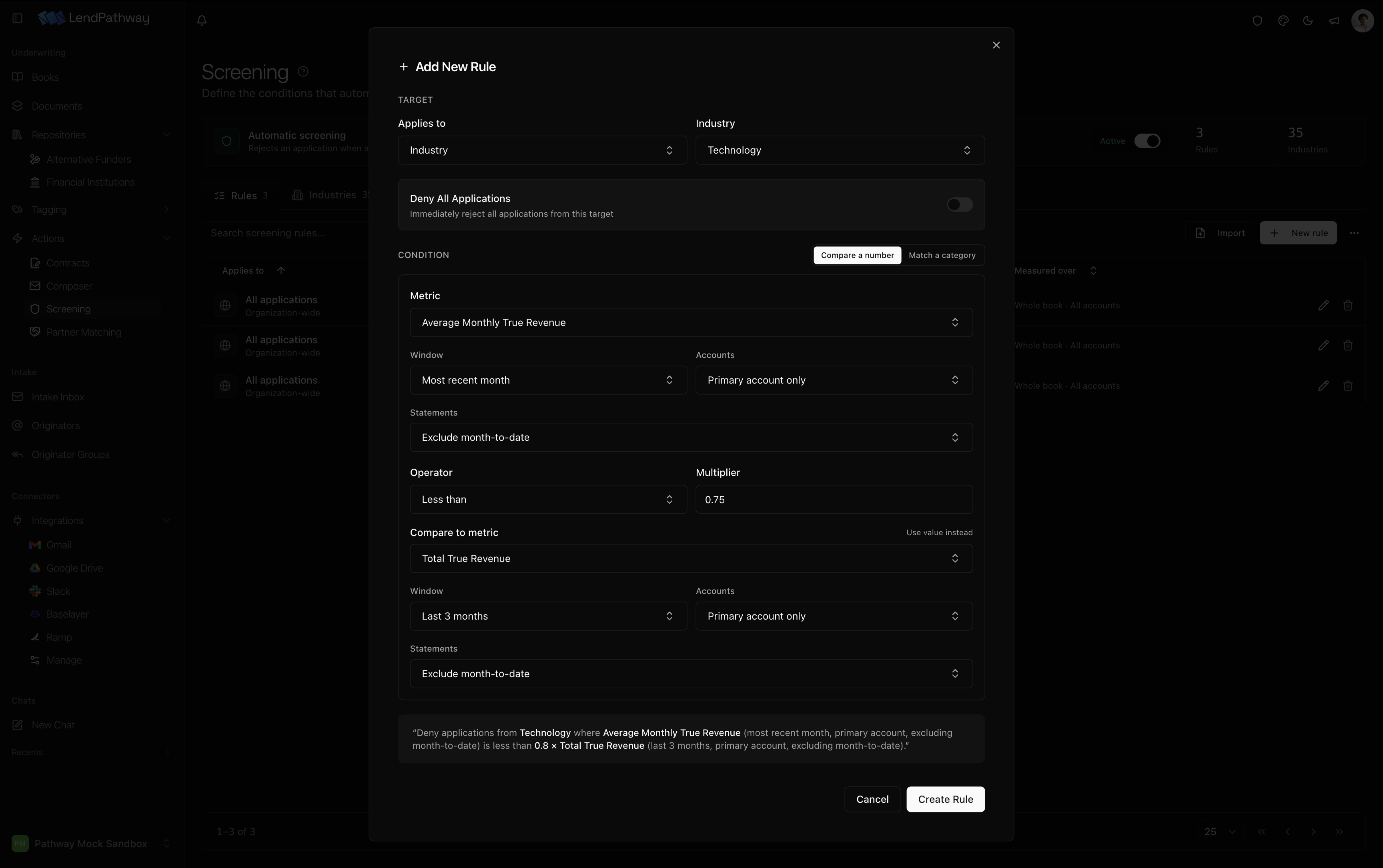
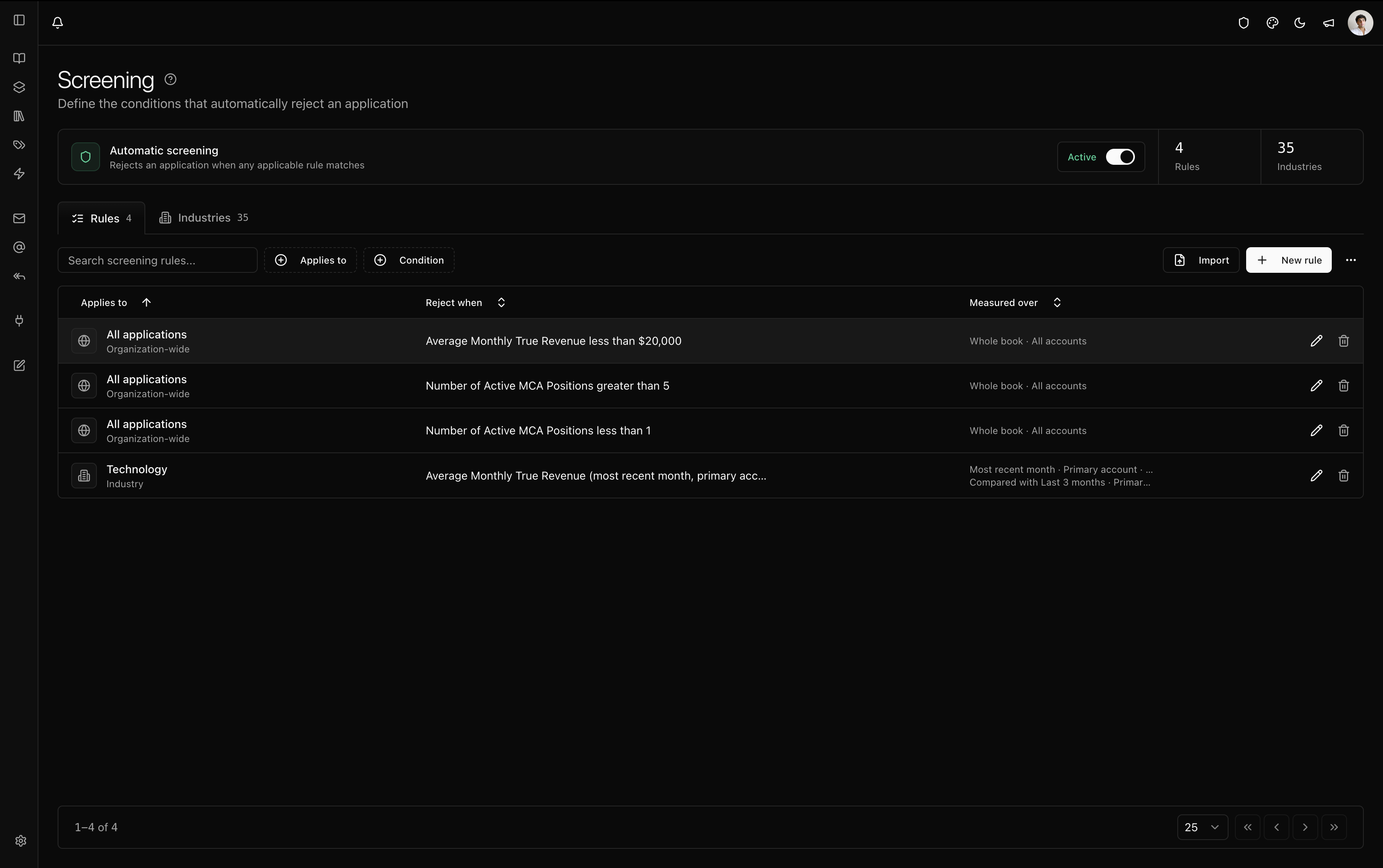
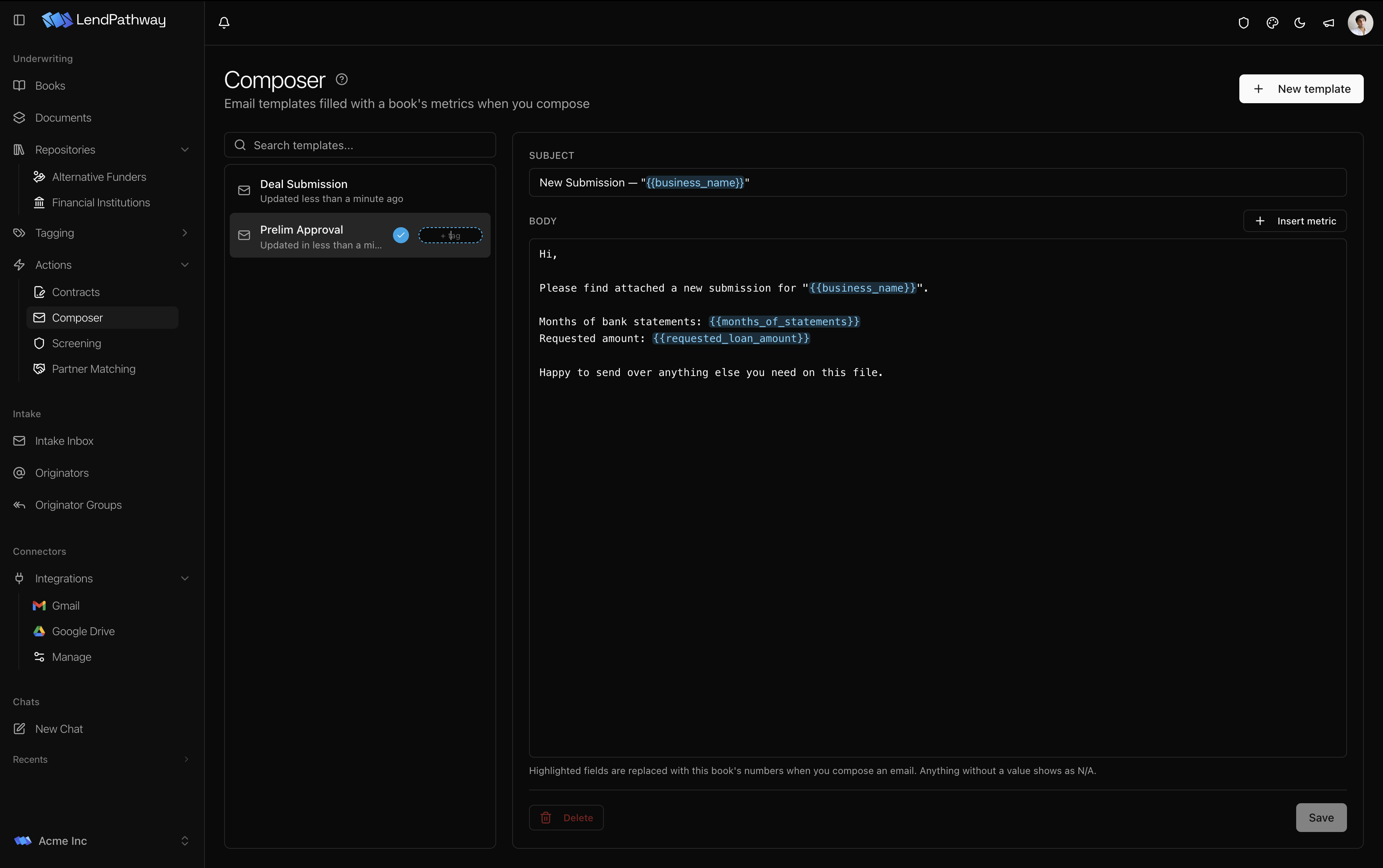
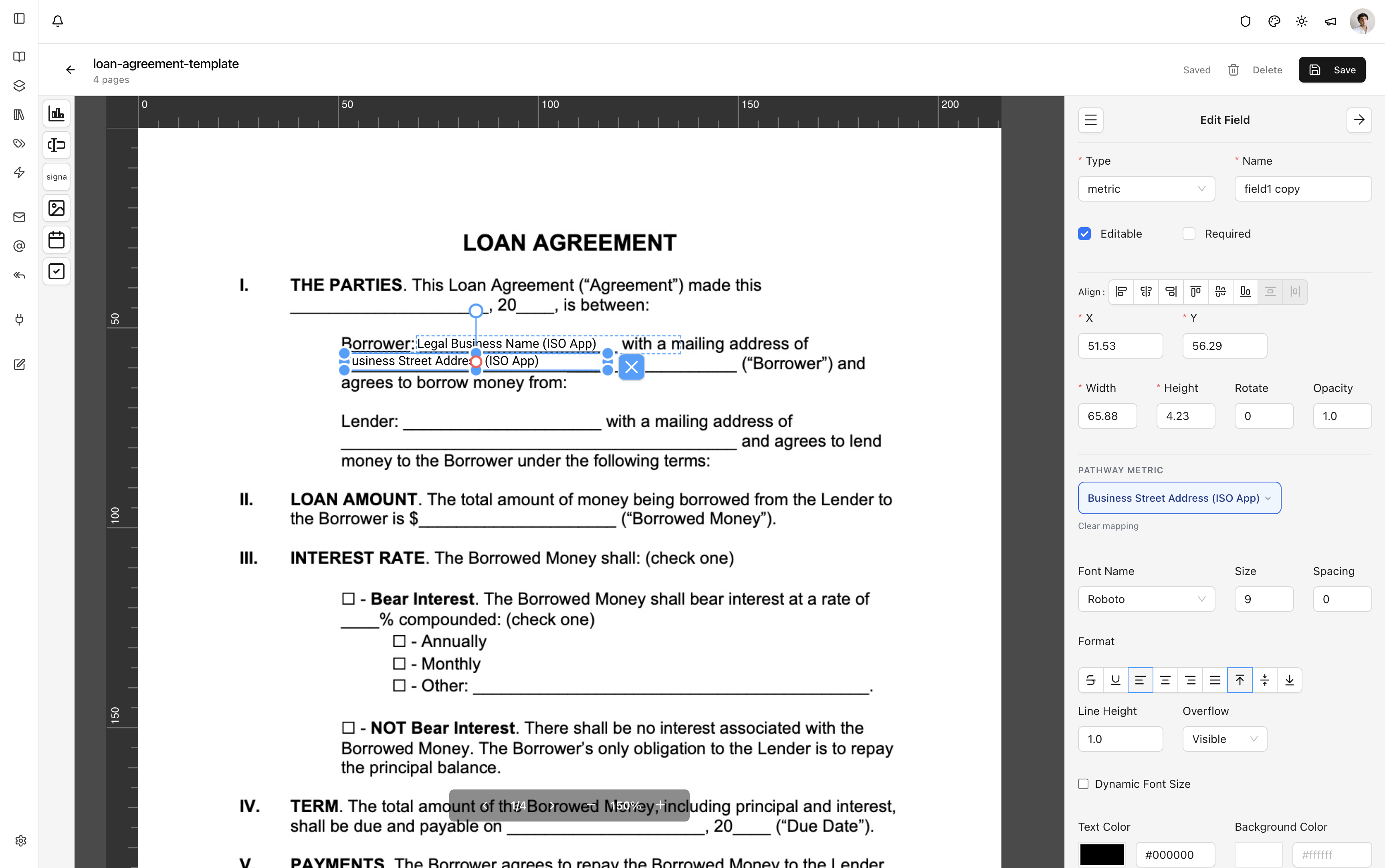
You can customize Excel templates for MCA stacking views, credit report summaries, and tax qualifying income worksheets. You can set custom transaction categories, define screening rules and auto-deny thresholds, and configure how revenue is calculated. Templates are versioned and configurable per organization.
Platform
Yes. Pre-built integrations with Salesforce, Gmail, Google Drive, and Slack. You can sync opportunities, push parsed data to custom fields, trigger parsing on deal creation, and export to your exact Excel templates. Every integration is configurable per organization. There is also a full REST API for custom workflows.
All data is encrypted in transit and at rest. Each organization's data is fully isolated at the application layer. Users in one organization cannot see, search, or interact with another organization's data. Source files are deleted on your schedule. For organizations that require complete data residency control, we support on-premises deployment.
Setup takes minutes. Connect your email, CRM, or API and start uploading documents. The platform adapts to your existing workflow. Forward emails, sync Salesforce deals, or call the API directly.

Ready to move paper faster?

Join hundreds of operators underwriting deals with Pathway. Set up in minutes. No workflow changes required.