Underwriting · Debt stack
Named counterparty detection.
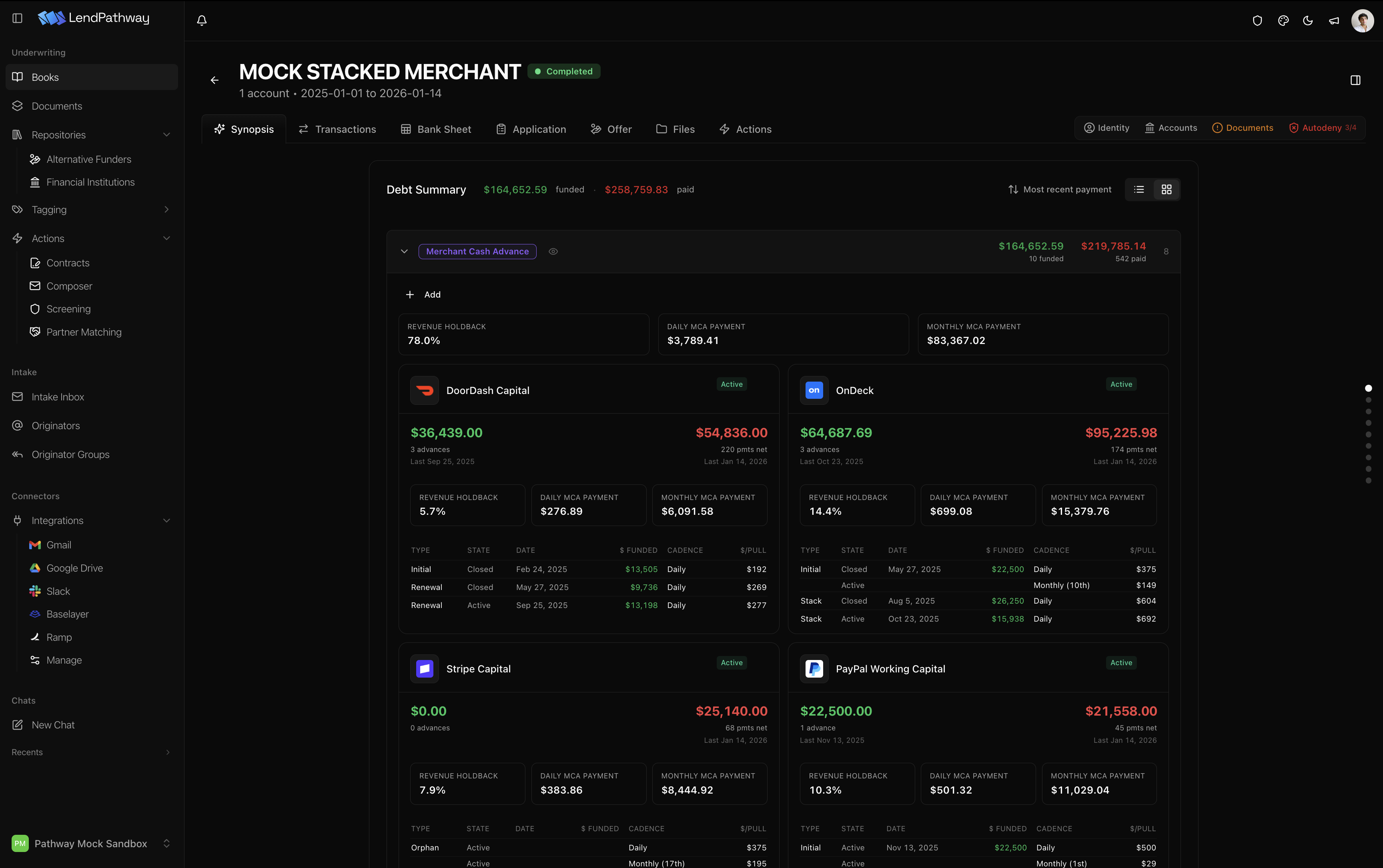
Pathway groups debt payments into positions and matches each MCA position to a funder in your registry. Each position is split into its original advance, renewals, and stacks, with payment schedules, daily remit, and holdback. Missed and modified payments are flagged from the transactions.
Positions
A tag records what kind of payment a transaction is. A position records which lender it went to. MCA payments are matched to funders through the transaction descriptions in your registry, with sponsor bank names such as Cross River and Pathward stripped so the funder’s name shows through. Bank loans, factoring, leases, and other debt are grouped by name similarity, so “GREENLINE CAPITAL” and “GREENLINE CAP” become one position.
Advances, renewals, and stacks
Each position is split into episodes: the initial advance, renewals, and stacks taken while an earlier advance was still pulling. Each episode has its own payment schedule with average amount, frequency, pull day, and daily-equivalent remit, and each position is marked just funded, active, or closed.
Missed and modified payments
A gap in a position’s payment cadence counts as a missed payment, cross-checked against bounced-payment reversals. An amount change with no new advance behind it counts as a modification. Both are counted separately for active and closed positions, and both are available to screening rules.
Totals across the stack
The debt board shows each position’s holdback, daily and monthly remit, amount paid net of bounced payments, and estimated payback, with totals across every MCA in the book. The same numbers fill the stack spreadsheets, the reply email, and screening.