Underwriting · Parsing
Line-item parsing, checked against the bank.
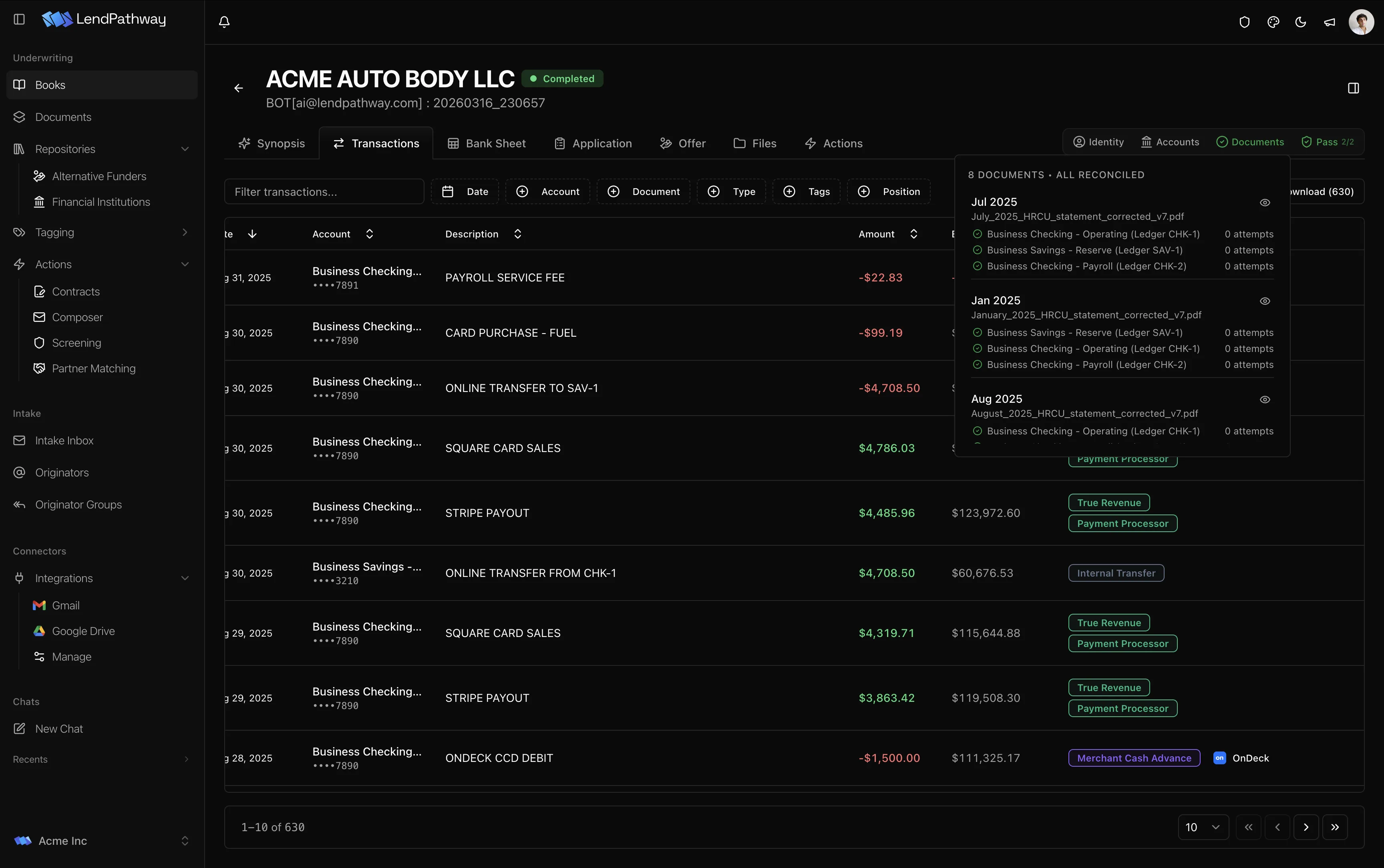
Each statement prints a starting and ending balance. Pathway walks every account’s transactions from one to the other and requires the result to land within five cents. When it misses, a correction agent fixes only what it can find in the PDF, and a ledger that still doesn’t balance is flagged with the reason.
Identity before transactions
Pathway first reads every statement in the deal together and resolves the business, its owners, and each distinct bank account. Each account gets a fixed ID, and extraction can only assign transactions to those IDs.
That context is used later. A transfer to ****4521 is tagged internal because ****4521 belongs to the business. A Zelle payment to a name on the application is tagged as an owner transaction.
Parallel extraction
One extraction agent runs per document, all at the same time. Amounts are stored as positive numbers with a separate credit or debit direction, which removes the sign errors vision models make when credits and debits share a column. Duplicate and overlapping statements are removed before extraction.
Reconciliation
The starting balance plus every signed transaction has to equal the printed ending balance within $0.05. The check runs per account per statement, so a transaction placed in the wrong account shows up as two ledgers off by the same amount in opposite directions.
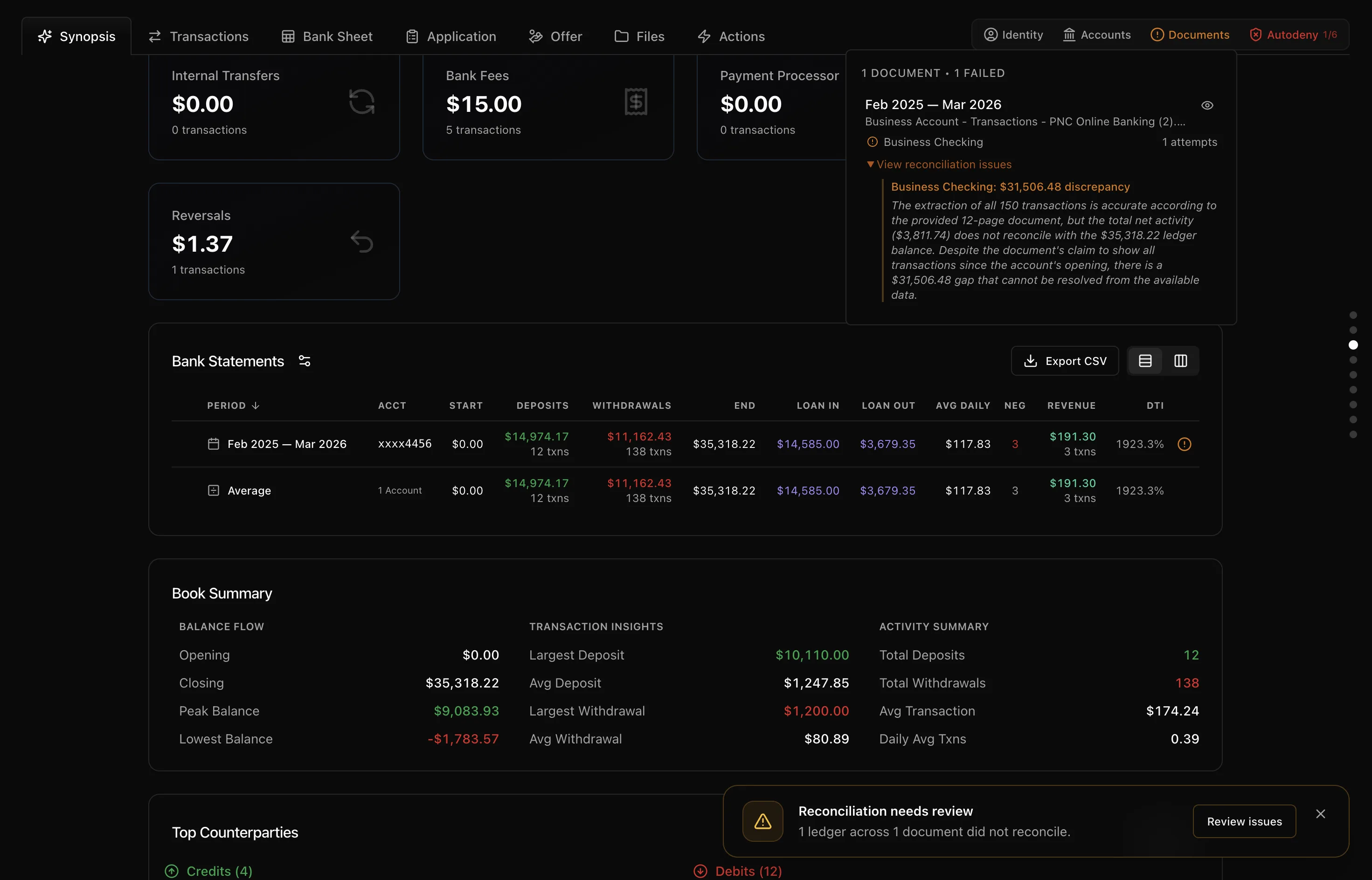
A ledger that fails goes to a correction agent with the source PDF, the extracted transactions, and the size and direction of the gap. It can flip a transaction’s direction, remove a row, or add one it finds in the document. It can’t edit descriptions or invent amounts. After three attempts, or when the bank’s own figures don’t add up, the ledger moves forward flagged with an explanation.
Tagging
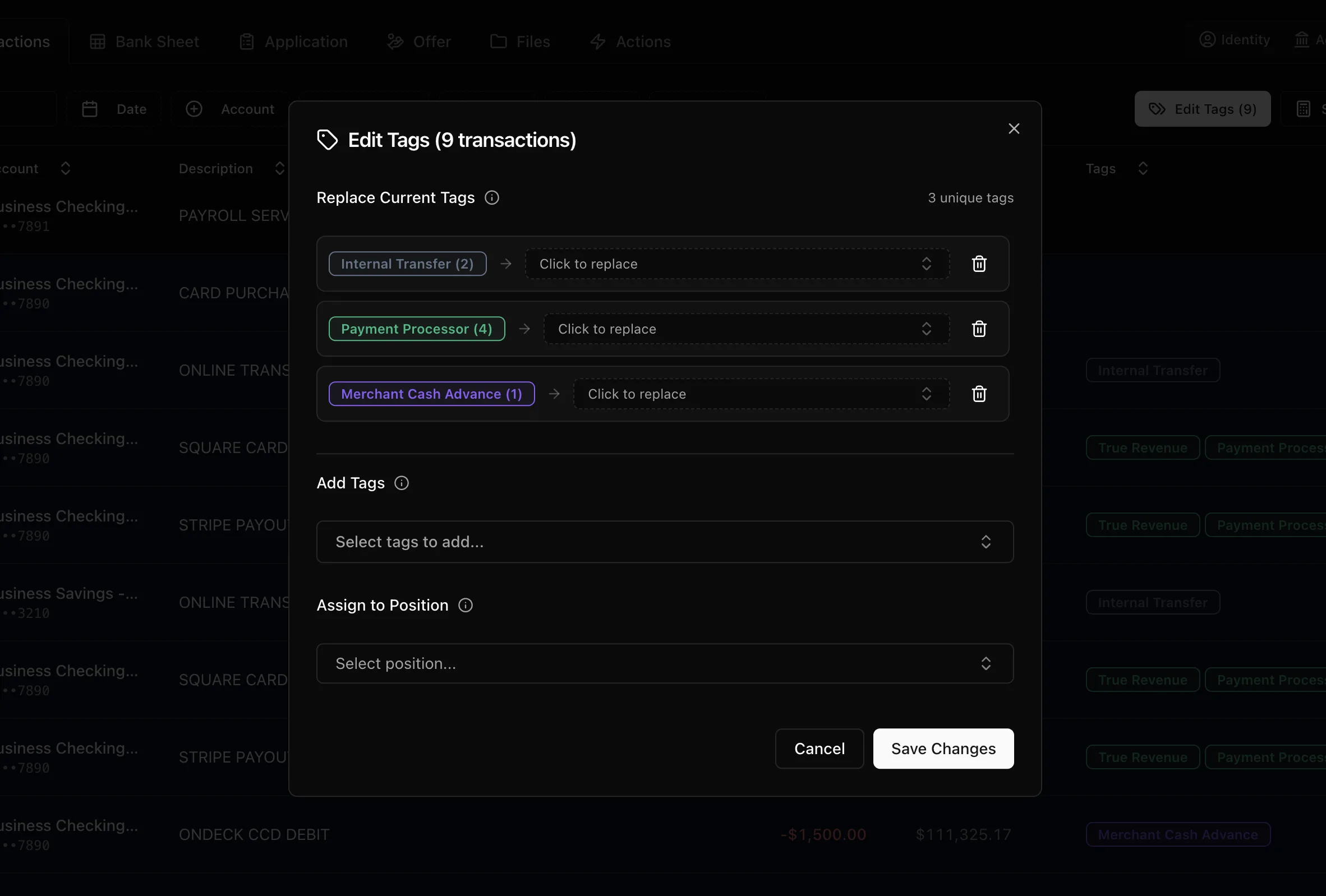
In a typical deal, about 800 transactions compress into about 120 description groups. Three classifiers tag them in parallel: deterministic rules for checks, wires, P2P, stop payments, NSFs, and overdrafts; a core model that knows the business’s accounts and owners; and a loan model with your funder registry in its prompt.
True revenue, debt-to-income, and every other metric are computed from the tags. Retag a group of transactions or assign them to a position, and every number, sheet, and screening verdict updates without a reparse.
Tampering detection
Each PDF’s structure is checked in parallel with tagging: how many times it was saved, creator and producer mismatches, creation and modification timestamps, and the fonts used. The signals are weighed together with the reconciliation result, because a statement that balances but was edited carries a different risk from one that fails and shows edits.
The tampering score, from 0 to 7, is available to screening rules.
Credit, tax, and other documents
Each document type has its own parser, and every result lands in the same book.
- Bank statements
- PDFs and scans from any bank, month-to-date pulls, multi-account statements, and Plaid asset reports.
- Credit reports
- Single-bureau and tri-merge, with every printed score and its model. A derogatory status needs printed evidence to count.
- Tax returns
- 1040, 1065, 1120, 1120-S, Schedule C, Schedule E, and K-1, with a qualifying income calculation.
- Loan applications
- Business, owners, entity type, and requested terms, editable in the book.
- Credit card statements
- Every line item typed, with spend categories and recurring charges.
- IDs and voided checks
- Classified and stored with the book.